Key takeaways
- French is uniquely hard to learn by ear due to liaison, elision, nasal vowels, silent letters, and fast speech (about 7.18 syllables per second).
- Dual subtitles connect sound, spelling, and meaning at once, closing the gap between written and spoken French.
- Pick content by level: Extra French for beginners, Lupin and Call My Agent for intermediate, The Bureau for advanced.
- A 20-minute daily routine of watching, shadowing, and journaling can reach conversational French in 4 to 6 months.
Why French Learners Are Ditching Apps for Netflix
French is one of the most popular languages to learn worldwide, studied by over 120 million people. It is also one of the most frustrating to listen to. The liaisons, the silent letters, the nasal vowels, the way native speakers seem to blur an entire sentence into a single flowing sound — these features make French uniquely challenging for listening comprehension.
This is exactly why app-based learning hits a wall for French learners faster than almost any other language. You can ace every conjugation quiz, memorize hundreds of vocabulary words, and still understand almost nothing when a Parisian speaks to you at normal speed. The gap between textbook French and real French is enormous.
Netflix and YouTube close that gap. They expose you to French as it is actually spoken — with contractions, slang, emotional inflection, humor, and regional variation. Combined with dual subtitles, streaming content becomes the most effective French listening practice available in 2026.
For the general approach to learning any language through media, see our guide on how to learn a language by watching. This article focuses specifically on French — the shows, the challenges, and the strategies that work for this language.
What Makes French Uniquely Challenging to Learn by Ear
Before diving into show recommendations, it helps to understand why French listening comprehension is so difficult — and why dual subtitles are particularly powerful for this language.
French has several phonological features that make it harder to parse aurally than most European languages:
- Liaison and enchaînement. French speakers link words together by pronouncing normally silent consonants when the next word begins with a vowel. "Les amis" sounds like "lay-zah-mee" rather than two separate words. Without seeing the text, your brain cannot determine where one word ends and the next begins.
- Elision. Vowels at the end of words are regularly dropped before words starting with vowels. "Je ai" becomes "j'ai." "Le homme" becomes "l'homme." Entire syllables disappear from speech.
- Nasal vowels. French has four nasal vowel sounds that do not exist in English. Words like "bon," "vin," "un," and "blanc" contain sounds that English speakers literally cannot distinguish without training.
- Silent letters everywhere. The word "beaucoup" has eight letters. You pronounce five of them. The word "oiseaux" (birds) contains none of the sounds that its individual letters would suggest. French spelling and pronunciation have a complicated relationship.
- Speed. Native French speakers average roughly 7.18 syllables per second in casual speech, making it one of the fastest spoken languages in the world. By comparison, English averages 6.19 syllables per second.
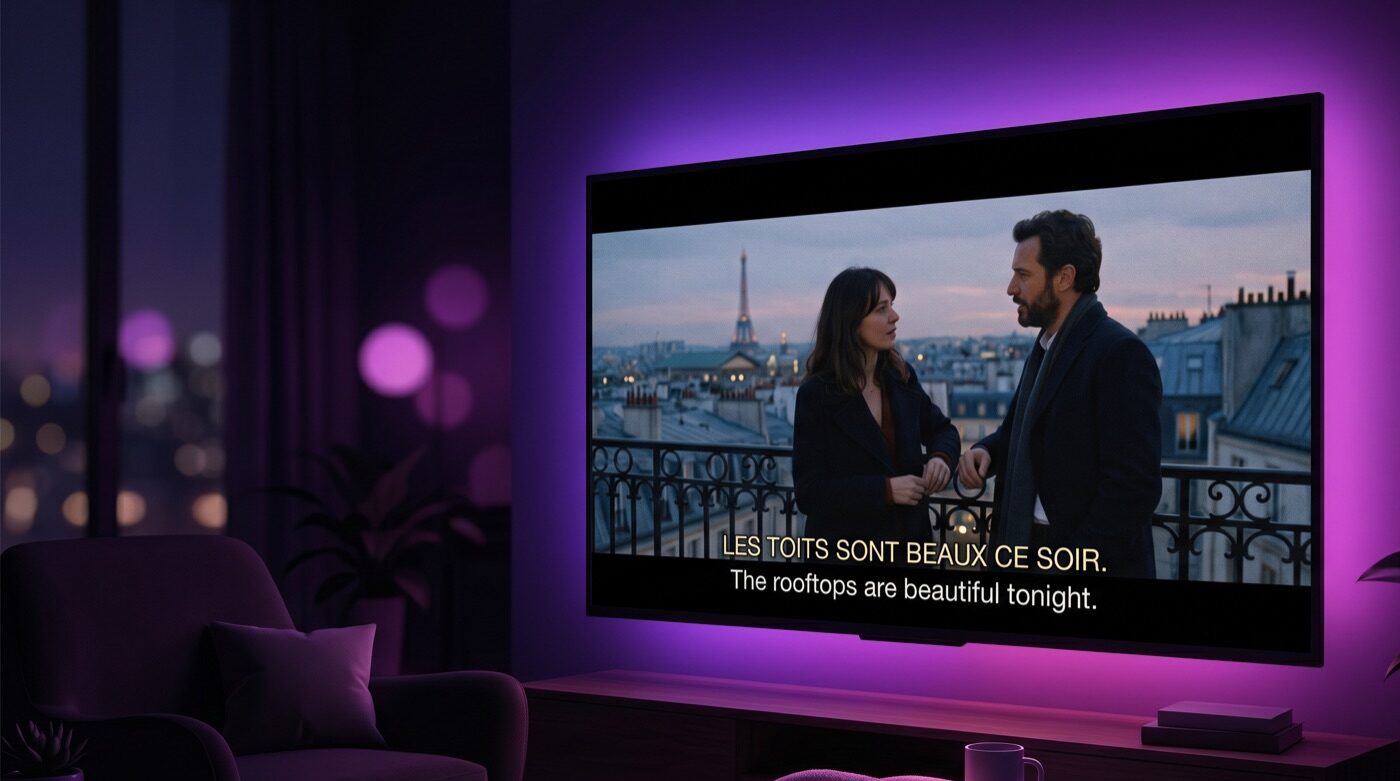
Dual subtitles address every single one of these challenges. When you hear "lay-zah-mee" and simultaneously see "les amis" written on screen with the English "the friends" below it, your brain makes three connections at once: the sound, the spelling, and the meaning. Over hundreds of hours, these connections become automatic. You stop hearing a blur and start hearing words.
Learn how to set up dual subtitles in our step-by-step guide: How to Get Dual Subtitles on Netflix.
Best Netflix Shows for Learning French by Level
Choosing content at the right difficulty level is essential. Too hard and you get frustrated. Too easy and you plateau. Here are our picks for every level, selected for clear audio, engaging storylines, and useful everyday vocabulary.
Beginner Level (A1-A2)
At the beginner level, you need slow, clear speech with visual context that helps you follow the plot even when you miss vocabulary.
- Extra French — A sitcom designed specifically for French learners. Slow, clear dialogue with physical comedy that provides visual context. The gold standard for A1 learners.
- Peppa Pig (French dub) — Short episodes, simple sentences, high repetition. Do not underestimate children's content for building foundational vocabulary.
- Le Petit Prince (animated series) — Beautiful animation with gentle, clear narration. Vocabulary is simple but varied.
- Miraculous: Tales of Ladybug & Cat Noir — Originally French. Animated action with clear dialogue, recurring vocabulary, and engaging plots that keep you watching.
Intermediate Level (B1-B2)
At the intermediate level, you can handle natural-speed dialogue but still benefit from dual subtitles for unfamiliar vocabulary, slang, and fast exchanges.
- Lupin — France's biggest Netflix hit. Modern Parisian French with clear enunciation from the lead actor. Mystery and heist elements keep you bingeing.
- Call My Agent (Dix pour cent) — Comedy-drama set in a Paris talent agency. Natural conversational French with humor, professional vocabulary, and celebrity cameos.
- The Hook Up Plan (Plan Coeur) — Romantic comedy with fast, modern Parisian slang. Excellent for learning informal French that textbooks never teach.
- Family Business — Comedy about a family that turns their kosher butcher shop into a cannabis cafe. Colloquial French, family dynamics vocabulary, and genuinely funny.
- Osmosis — French sci-fi set in near-future Paris. Clear dialogue with technology and relationship vocabulary. Interesting if you like Black Mirror-style concepts.
Advanced Level (C1-C2)
Advanced learners should seek out content with fast dialogue, regional accents, heavy slang, and complex themes to push toward near-native comprehension.
- The Bureau (Le Bureau des Légendes) — Widely considered one of the best French series ever made. Spy thriller with sophisticated dialogue, political vocabulary, and multiple accents including North African French.
- Marseille — Political drama set in southern France. Marseille accent is notably different from Parisian French. Excellent for training your ear to regional variation.
- Inhuman Resources (Dérapages) — Psychological thriller with corporate and legal vocabulary. Fast, intense dialogue.
- French standup specials — Gad Elmaleh, Blanche Gardin, and others. Standup comedy is the ultimate listening test: fast, culturally dense, full of wordplay and slang.
- Engrenages (Spiral) — Crime procedural with legal and police vocabulary. Realistic Parisian dialogue including verlan (French back-slang).
Best YouTube Channels for Learning French
YouTube complements Netflix by providing unscripted, natural French. Real people speaking at real speed with real accents. This is messier than scripted TV, which makes it perfect for pushing your comprehension past the intermediate plateau.
Use dual subtitles on YouTube with the same Funlingo extension. For setup details, see our guide to bilingual subtitles on YouTube.
- InnerFrench (Hugo Cotton) — Specifically designed for intermediate French learners. Hugo speaks at a natural but slightly moderated pace about interesting topics: French culture, psychology, travel, current events. The best single YouTube resource for B1-B2 learners.
- Cyprien — One of France's biggest YouTubers. Comedy sketches about everyday life in fast, natural French. Heavy on slang and modern expressions.
- Squeezie — Gaming and entertainment content. Very fast, very casual, very young French. Not for beginners, but incredible for training your ear to how young French people actually talk.
- Nota Bene — French history channel with clear narration and sophisticated vocabulary. If you like history, this builds academic French naturally.
- Cuisinez avec Antoine — French cooking with step-by-step narration. Kitchen vocabulary plus the satisfaction of actually cooking what you watch. Food is culture, and French food vocabulary is surprisingly useful in daily conversation.
- France 24 (French) — International news in French. Clear journalist pronunciation, current events vocabulary, and formal register French that balances out the informal register from entertainment content.
The Dual Subtitle Method for French
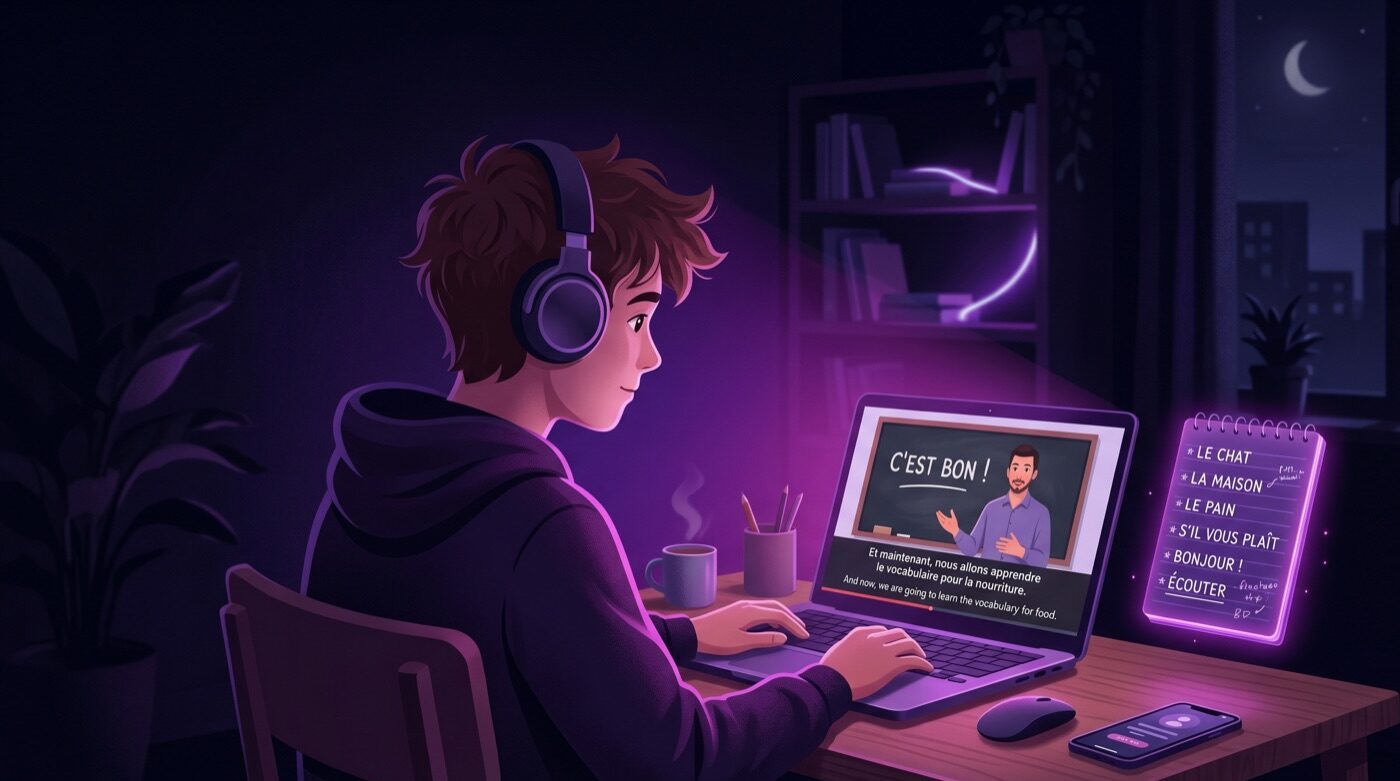
The dual subtitle method is especially powerful for French because of the language's massive gap between written and spoken form. Seeing "je ne sais pas" on screen while hearing "shay-pah" is the single fastest way to decode French phonology.
Decode Liaison Patterns
See where words link and blend in real time. Your brain learns to predict liaisons before they happen.
Train Nasal Vowels
Hearing nasal vowels while reading their spelling builds the neural pathways that English-only ears lack.
Natural Repetition
Characters repeat phrases across episodes. High-frequency expressions like "c'est pas grave" and "du coup" cement themselves naturally.
Click to Save Words
Click any French word in the subtitles for an instant definition. Save it to review later with spaced repetition.
For a detailed comparison of all dual subtitle tools available, see our best dual subtitle extension comparison. For Netflix-specific setup, here is our guide to Netflix language learning extensions.
Your 20-Minute Daily French Routine
Consistency beats intensity for language acquisition. This routine is designed to fit into any schedule while maximizing the four skills that matter most: listening, reading, vocabulary, and pronunciation.
Daily French Learning Routine
Twenty minutes per day, every day. This builds listening, reading, vocabulary, pronunciation, and writing simultaneously. For more on building sustainable habits, see our guide to daily language learning habits.
French-Specific Vocabulary Strategies
French shares thousands of cognates with English thanks to the Norman Conquest of 1066. Words like "information," "restaurant," "situation," and "important" are immediately recognizable. This gives English speakers a massive head start in reading comprehension.
But there are also faux amis (false friends) that trip learners up constantly. "Actuellement" means "currently," not "actually." "Bras" means "arm," not what English speakers think. "Attendre" means "to wait," not "to attend." Dual subtitles catch these instantly — you see the French word, read the English meaning, and your brain corrects the false association before it cements.
For deeper strategies on capturing and retaining vocabulary from watching, read our guide on how to build vocabulary while watching shows and the companion piece on vocabulary building strategies for watching.
High-Value French Phrases You Will Hear Constantly
These phrases appear in nearly every French show and film. Recognizing them is the first step to understanding natural French speech.
- "Du coup" — "So" or "as a result." The most overused filler in modern French. You will hear it ten times per episode.
- "C'est pas grave" — "It's not a big deal." Note the dropped "ne" — in spoken French, the "ne" in negation is almost always omitted.
- "En fait" — "Actually" or "in fact." Another extremely common discourse marker.
- "N'importe quoi" — "Whatever" or "nonsense." Used to dismiss something ridiculous.
- "Ça y est" — "That's it" or "it's done." Used when something is accomplished or when you've had enough.
- "Quand même" — Roughly "still" or "anyway" or "even so." One of the hardest French expressions to translate because its meaning shifts with context.
- "Bref" — "Anyway" or "in short." Used to wrap up a tangent or summarize.
- "T'inquiète" — Short for "ne t'inquiète pas" (don't worry). Casual, ubiquitous.
Common Mistakes French Learners Make with Immersion
The dual subtitle approach is powerful, but there are pitfalls that can slow your progress if you are not aware of them.
- Only reading the English line. This is the most common mistake. If your eyes default to the English subtitle and you stop listening to the French audio, you are just watching TV with subtitles. Force yourself to read the French line first. Let the English line be a safety net, not a crutch.
- Starting with content that is too difficult. Jumping straight into The Bureau as a beginner is a recipe for frustration. Start with content designed for learners or children's shows, then gradually increase difficulty.
- Passive watching without engagement. Having dual subtitles on while scrolling your phone defeats the purpose. Active watching means your eyes are on the screen, you are reading the French text, and you are clicking words you do not recognize.
- Never removing the scaffold. Dual subtitles are training wheels. After three to four months, start watching some content with only French subtitles. After six months, try episodes without any subtitles. Gradually reduce the support as your comprehension grows.
- Ignoring speaking practice entirely. Input is the engine of acquisition, but you still need output practice. After two to three months of solid input, add speaking practice through language exchange apps or tutoring sessions.
The 6-Month French Roadmap
Here is a realistic timeline for going from beginner to conversational French using the dual subtitle immersion method.
Month 1-2: Foundation
Watch beginner content (Extra French, animated shows) with dual subtitles. 20 minutes daily. Focus on recognizing common words and phrases. Save 5 to 10 words per session to Anki. You should recognize about 500 words by the end of month two.
Month 3-4: Acceleration
Transition to intermediate Netflix content (Lupin, Call My Agent) with dual subtitles. Add YouTube channels like InnerFrench. Increase to 30 minutes daily. Begin shadowing exercises two to three times per week. Start noticing that you understand phrases before reading the English subtitle. Vocabulary target: 1,500 words.
Month 5-6: Independence
Watch some content with French-only subtitles. Try episodes without any subtitles for content you have already seen. Add weekly speaking practice through HelloTalk, Tandem, or italki. You should be able to follow most of a familiar show without English support and hold basic conversations. Vocabulary target: 3,000 active words.
This timeline assumes 20 to 30 minutes of daily watching. More time produces faster results, but consistency matters far more than intensity. For the science behind why daily habits outperform weekend marathons, see our article on the complete Netflix language learning approach.
Tools You Need (All Free)
- Funlingo (Chrome extension) — Dual subtitles on Netflix and YouTube with click-to-translate and vocabulary saving. Free. This is the core tool for the entire method.
- Anki (desktop version) — Free spaced-repetition flashcard app. Import words you save from watching sessions. Review for 5 to 10 minutes daily.
- Language Transfer (French) — Free audio course that teaches French grammar through patterns rather than rules. Excellent supplement to listening practice.
- HelloTalk or Tandem — Free language exchange apps for finding French speakers who want to practice English. Add speaking practice after month two to three.
For a comprehensive comparison of all available tools, see our guide to the best AI language learning tools in 2026.
Frequently Asked Questions
Watching with dual subtitles builds strong listening and reading comprehension. For full fluency, combine it with vocabulary review, grammar study, and speaking practice.
Beginners: Extra French, Miraculous Ladybug. Intermediate: Lupin, Call My Agent, The Hook Up Plan. Advanced: The Bureau, Marseille, French standup specials.
Use dual subtitles showing both at once. This trains your ear, teaches spelling, and confirms meaning simultaneously.
With 20 to 30 minutes daily, expect noticeable improvement in 8 to 12 weeks. Conversational ability typically develops in 4 to 6 months with added speaking practice.
Both are valuable. Netflix for scripted, clear audio. YouTube for natural, unscripted speech. Use both for the best results.
Funlingo for dual subtitles (free Chrome extension), Anki for flashcards (free desktop), Language Transfer for grammar (free audio), and HelloTalk for speaking practice (free app).